
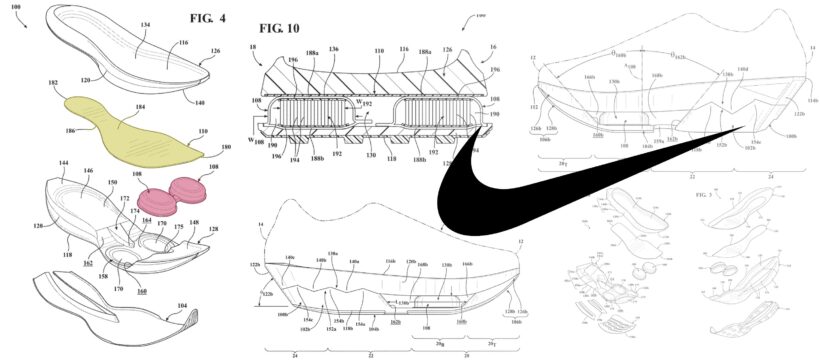
The patent application closest to the Nike Alphafly 3 describes a simpler sole: the two Air Zoom pods now sit on the foam instead of the outsole. A second version, strongly focused on stability, suggests Nike is preparing a training shoe.
In this article: the details of the Alphafly 3 sole, and a surprise
You have probably seen the new Nike Alphafly 3 on social media, photographed at various races or on Kipchoge’s feet, with tape hiding the Air Zoom pod at the front of the shoe.
What changes in the sole of the new Alphafly 3
Last April a patent application was published that looks very close to what seems to be this new Alphafly. It mainly covers the sole construction, which differs clearly from the previous generation.
What stands out is how “simple” the new construction is compared with the first Alphafly. The first generation had nine parts: a three-piece outsole, a two-piece lower midsole, a one-piece upper midsole, and of course the two Air Zoom pods and the carbon plate.

The major parts stay: the two Air Zoom pods (pink), which cushion the foot by compressing resiliently and further damp ground reaction forces, the carbon plate (yellow) and the outsole (although the application also proposes a one-piece outsole variant). The supercritical foam construction and the integration of the pods are completely reworked.
The pods used to sit in recesses in the front of the outsole. They now sit in recesses in the lower part of the midsole. This changes the lower midsole significantly: it used to be split in two, and is now one piece running uninterrupted from heel to toe.

This pod layout contributes to better stability and lateral support, ideal for multidirectional movement.

The two foam layers could also have different properties: the upper layer could use a foam with better cushioning and shock distribution, and the lower layer a firmer foam for stability. Nike does not seem to have made that choice on this version of the Alphafly 3, or at least it is not visible.

The application also shows that the size of the recess holding the pods sets the flexibility of the forefoot: the longer it is, the more flexible the sole.
The second, less obvious change is the shape of the rear of the sole at the heel. According to Nike’s designers, this blunted profile gives better stability and longitudinal support during heel strike while keeping the sole light. It can improve comfort and performance when walking or running. Those who follow the brand’s prototypes closely will have noticed that this area changed between the “black” prototype (the first one seen) and the white one (seen at the Tokyo Marathon).
A souped-up version of the Nike Alphafly 3?
Another version described in the application is strongly focused on stability. Could a rival to the adidas Prime X or the New Balance SC Trainer be hiding behind this shoe?

Built on the same construction, this version has a few specific features:
- The rear of the upper structure fits into the lower part. Both parts are trapezoidal, for stability.

The trapezoidal shape of the rear of the sole - The two parts interlock with mountain-shaped profiles, which maximises the contact area between the upper and lower cushioning members and therefore improves the shoe’s stability.
- A groove (yellow) runs across the front of the lower sole. It gives more lateral flexibility at the toes; in other words, the pods can bend more easily from side to side under the toes.
- The lower part also has an opening (red) on the medial side of the shoe (as seen on the adidas Adizero Pro, for example), which improves the shoe’s torsional movement.


Conclusion
I had already discussed better pod integration two years ago, with another patent (in French). With this new Alphafly, it is done. The ride is likely to feel different, with the pod resting on foam rather than on the outsole. But I do not think Nike will stop there: the brand is absent from the super trainer market (Prime X, SC Trainer), even though those shoes use technologies Nike masters. The second option in the patent looks like a good bet for seeing the American brand enter that segment.
Further reading (in French)
- The new Puma Fast FWD Nitro Elite, taken apart: an almost flat plate and a sole with a strong rocker
- The Salomon S/Lab Spectur, without the test run: a rigid blade and a two-winged support
Method. This article is based on patent applications from Nike, filed in October 2022 and published in April 2023. For convenience I write “patent” throughout, but these are applications: until they have been examined and granted, they do not give the rights of a patent, and their claims may still change or be refused. This analysis does not predict the brand’s future releases: it may reflect the designers’ work. Translated from the original French article.
Leave a Reply