
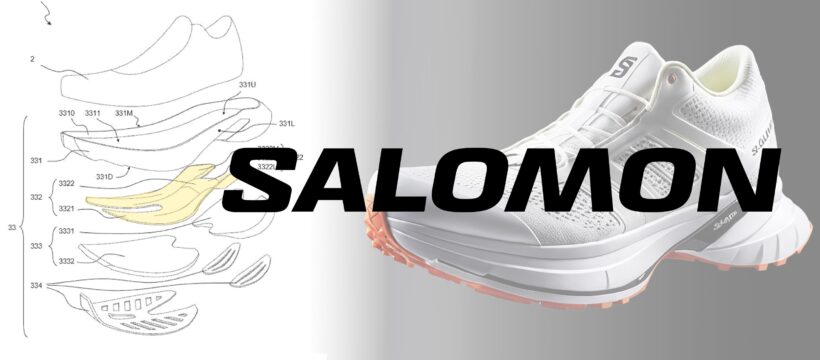
The patent application behind the Salomon S/Lab Spectur describes a rigid blade covering more than the front half of the sole, combined with a two-winged support, all in one piece. The goal: stiffen the forefoot without losing comfort.
In this article: what lies under the plate of the Salomon S/Lab Spectur
If you follow shoe news, you have probably seen the upcoming Salomon S/Lab Spectur, a shoe for marathoners running over 3:30 who want a high-performance product close to a super shoe.
Salomon’s recent patent application focuses on the sole, a key part of the shoe that can strongly affect running performance. Its main aims are to optimise how the sole deforms on impact, to increase resilience (its ability to store and return energy), to improve the roll of the foot and to strengthen propulsion. In doing so, the sole aims to absorb shocks better, add stability and give a smooth transition from heel to metatarsals.
Several studies went into this shoe. Some findings appear in the paper by the University of Lyon and Salomon: Individual physiological responses to changes in shoe bending stiffness: a cluster analysis study on 96 runners.
The Salomon S/Lab Spectur sole in detail
At the heart of the invention is a rigid blade placed mainly in the front half of the sole. It covers at least 50% of the projected ground area of that zone, which gives enough support and stiffness. The blade stiffens the sole under the metatarsals, limiting their bending and therefore the energy lost when the metatarsophalangeal joint flexes.
Combined with an upturned forefoot (rocker), the rigid plate plays a key role in improving the runner’s performance.
When the front of the sole curves upwards (the “rocker” effect), it creates a pivot point just ahead of the base of the toes. This design helps the foot roll forward while running. The rigid plate inside this curved sole strengthens the effect: when the runner pushes on the front of the shoe, the plate transfers that energy more efficiently and helps propel the runner forward.
The blade is combined with a transverse support. This is Salomon’s extra touch.

For extra support, it has two wings. The lateral and medial wings extend the rigid support along the sides of the sole to give additional lateral and medial support. The support restrains the sideways expansion of the upper cushioning layer, which increases the sole’s resilience and improves stability. On the S/Lab Spectur, blade and support form a single part: a plate covering more than half the shoe, with two wings at least 10 mm wide.
Materials and manufacturing
The rigid blade is made of materials with an elastic (Young’s) modulus above 750 MPa but below 70 GPa, a compromise between stiffness and comfort. This also keeps it outside the scope of Nike’s plate patent. Its average thickness is between 0.7 and 2 mm. Possible materials include polyamide (PA), thermoplastic polyurethane (TPU), or composites with glass, carbon or flax fibres. The wings are at least five times less stiff than the blade.
This rigid chassis can be made by two-shot injection, using different materials for the blade and for the support to get the desired difference in stiffness.
Another option is to form a hollow in the blade under the arch, so the chassis makes a bump facing the foot. The hollow increases bending and torsional stiffness with less thickness, and prevents sole deformations during the transition phase that could waste energy.
The cushioning layer is a cellular foam, using materials such as ethylene-vinyl acetate (EVA), polyurethane (PU), TPU, polyester-based thermoplastic elastomer (TPEE), polyether block amide (PEBA) or thermoplastic polyolefin (TPO/POE). These are chosen for shock absorption and energy return. This is where Salomon’s EnergyFoam+ and EnergyFoam come in.
Let’s have some fun
Here is a new experiment. Even though the shoe is already out, I used a generative AI to create variations of the shoe from the sketches in the patent. I found the result quite striking, and it is a tool I will probably use again to explore future innovations.


Conclusion
Salomon also offers a version that seems to give runners more stability. It may look minor, but it shows how much individual behaviour matters when assessing running shoes. The paper cited above suggests that runners respond differently to a stiffer sole, and that high-level runners benefit from stiffer soles. A range of products is needed, adapted to each runner’s needs.
Further reading (in French)
- The secrets of the two blades in the Hoka Tecton X: two independent plates for trail running
- The secrets of the future adidas Adios Pro 3: reinforcing rods instead of a plate
Method. This article is based on patent applications filed by Salomon in October 2022 and published in April 2024. For convenience I write “patent” throughout, but these are applications: until they have been examined and granted, they do not give the rights of a patent, and their claims may still change or be refused. This analysis does not predict the brand’s future releases: it may reflect the designers’ work. Translated from the original French article.
Leave a Reply