
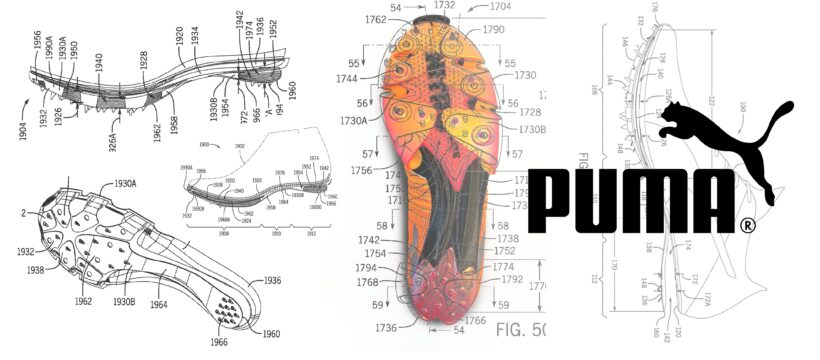
Puma’s patent application describes a track spike sole with two gaps, one under the metatarsals and one under the heel, that can hold a comfort element. Karsten Warholm’s evoSPEED Naio Nitro Elite uses a version adapted to World Athletics rules.
In this article: inside Puma’s new evoSPEED Naio NITRO Elite
For a change, today we look at a track shoe.
Track spikes
Running on the track, from 60 m to 10,000 m, is not like running a marathon. As an introduction, here is an interesting paper: Can We Quantify the Benefits of “Super Spikes” in Track Running?, by Laura Healey, Montgomery Bertschy, Shalaya Kipp and Wouter Hoogkamer. Laura currently works for Puma, and so does Wouter. If the names Wouter Hoogkamer or Shalaya Kipp ring a bell, that is normal: they were behind the original 4% paper on Nike’s VaporFly.
Even if some mechanisms carry over, sprint and distance differ enough to have different needs. On the road the aim is mostly energy “economy”, a metabolic cost. In sprinting, what matters is acceleration and top speed, which depend on how much horizontal propulsive force is produced at a given speed: a force-velocity characteristic of the athlete.
In short, to improve performance, spikes must let an athlete run faster by increasing acceleration, top speed and/or running economy. The biomechanical and energy demands of each track event vary with distance, so spikes need to be adapted to each distance.
The first thing the paper shows is that “super spikes”, the new shoes with resilient foam and a composite plate, are poorly documented, if at all: everyone looked at the road, which is easier to measure. The same levers come up, though:
- Stiffness: longitudinal bending stiffness matters for the marathon as for the track. Stiffer bending reduces the energy lost at the metatarsophalangeal (MTP) joint. When running and sprinting, the joint dorsiflexes during stance, absorbing mechanical energy, and stays flexed for most of the push-off, returning little of it. It sounds simple on paper, and this kind of plate has existed in athletics for a long time, but in practice some athletes respond and others do not.
- Foam: the big change of recent years. Lighter and more compliant, it adds comfort to what used to be a very minimalist spike.
- Geometry, especially stack height, which World Athletics now caps at 20 mm up to 800 m and 25 mm above.
Why is it so hard to quantify?
There are two effects to measure: on running economy, and on top speed and acceleration. The first is fairly simple: as with a super shoe, you run at a steady aerobic pace. But that misses much of what happens on the track, whether short events or the last lap of a 10,000 m. Sprinting is anaerobic, high-intensity work. It is hard to repeat under the same conditions, and measuring anaerobic metabolic energy is unreliable and/or requires very invasive equipment. Some researchers have used blood lactate to estimate this cost, but it is not the right marker here.
Puma’s patent
The principle of Puma’s patent is to add two gaps to the midsole: one at the rear under the heel, and one further forward under the metatarsal heads.
The front gap is curved to give a pronounced rocker. Its height varies along the curve, first increasing from the forefoot to a maximum, then decreasing towards the midfoot. The maximum height of the front gap sits under the first metatarsal head.
In the same way, the rear gap grows in height from the midfoot to a maximum under the runner’s heel.
In some configurations, Puma’s designers propose placing a comfort element in this space. Think of something like the Zoom Air unit of the Nike Air Zoom Victory, placed at the front of the shoe. The element can be made of supercritical foam (TPU, EVA or PEBA) or a plain EVA foam (such as PUMA ProFoam Lite or IGNITE Foam).


Puma gives some detail on the expected compression of each zone.
For a front-zone height h1 at rest, expect 5 to 10% compression when standing and 50 to 90% when running. The rear zone h2 compresses 10 to 30% standing and 90 to 100% running.
The patent details include the usual claims for this kind of “shock absorber”: absorbing impact forces, a spring effect when pressure is released, less stress on the foot and tendons, and so on. They can leave you sceptical, all the more for a pair of spikes.
The evoSPEED Naio NITRO Elite
 You have probably already seen a pair of spikes based on this patent: the evoSPEED Naio Nitro Elite, worn by Karsten Warholm at the 2022 World Championships in Eugene and at the recent European Championships in Munich. One of the embodiments in the patent is close to the German brand’s new model. On it, the front volume is defined by six segments that also carry the spikes. The U shape of the segments (green) gives the flexibility needed to compress the comfort element (yellow) in the middle of the gap. Ribs (light green) stiffen the central part of the sole and help support the arch. On Puma’s shoe, this part is carbon. A similar system sits under the heel, with two U-shaped segments and a cushioning insert.

The result is a continuous, almost one-piece structure on two levels, one of which carries the spikes. This continuous part is one of the differences with the evoSPEED Naio NITRO Elite, because Puma had to comply with World Athletics rules (which are sometimes shaky on shoes: what exactly does “rigid” mean?). On the shoe, the carbon part runs to the front of the sole and the U segments are attached to it, whereas in the patent the front part is one piece attached to the middle section.


Here is why. The rule says:
10.6 Until further notice, unless in exceptional circumstances and specifically agreed by the Competition Commission in writing, any Athletic Shoe used in Applicable Competitions:
- 10.6.1 (except where Regulation 10.6.3 applies) must not contain more than one rigid structure (e.g. plate, blade etc.) whether that structure runs the full length of the shoe or only part of the length of the shoe;
- 10.6.2 the one rigid structure referred to in Regulation 10.6.1 may be in more than one part, but those parts must be located in one plane (i.e. must not be stacked above each other, must not overlap);
- 10.6.3 may contain one additional rigid structure or other mechanism (e.g. plate, blade etc.) only where used solely to attach spikes to the outer underside of the shoe. For the avoidance of doubt, the additional rigid structure to attach spikes cannot be a continuation of the rigid structure referred to in Regulation 10.6.1;
10.6.1: no problem, only one structure is visible in the photo.
10.6.2: this is where it gets tricky, because there are two planes. One is close to the foot, on top of the carbon midsole (PWRPlate); the other is formed by the U segments that come back down close to the ground. They are therefore stacked over part of the forefoot.
10.6.3: the second part carries the spikes, and what saves Puma entirely is making it in TPU, to distinguish it from the carbon plate.
Conclusion
With this patent, Puma seems to have secured a family of sole constructions aimed at the track, with front and rear gaps, with or without a comfort insert. Puma’s almost one-piece construction is very interesting, but the rules currently limit this kind of structure, which led to some changes for the evoSPEED Naio NITRO Elite. It remains to be seen whether they will go all the way, with a rear gap too, for longer events such as the 5,000 and 10,000 m.

You can sense that “plates” are becoming more complex: 3D structures with several functions. This part is likely to become more and more integrated, and the World Athletics rules will soon be outdated.
Further reading (in French)
- The new Puma Fast FWD Nitro Elite, taken apart: an almost flat plate and a sole with a strong rocker
- The secrets of the future adidas Adios Pro 3: reinforcing rods instead of a plate
Method. This article is based on patent application WO2022157582A1 from Puma SE, filed in December 2021 and published in July 2022. For convenience I write “patent” throughout, but this is an application: until it has been examined and granted, it does not give the rights of a patent, and its claims may still change or be refused. This analysis does not predict the brand’s future releases: it may reflect the designers’ work. Translated from the original French article.
Leave a Reply