
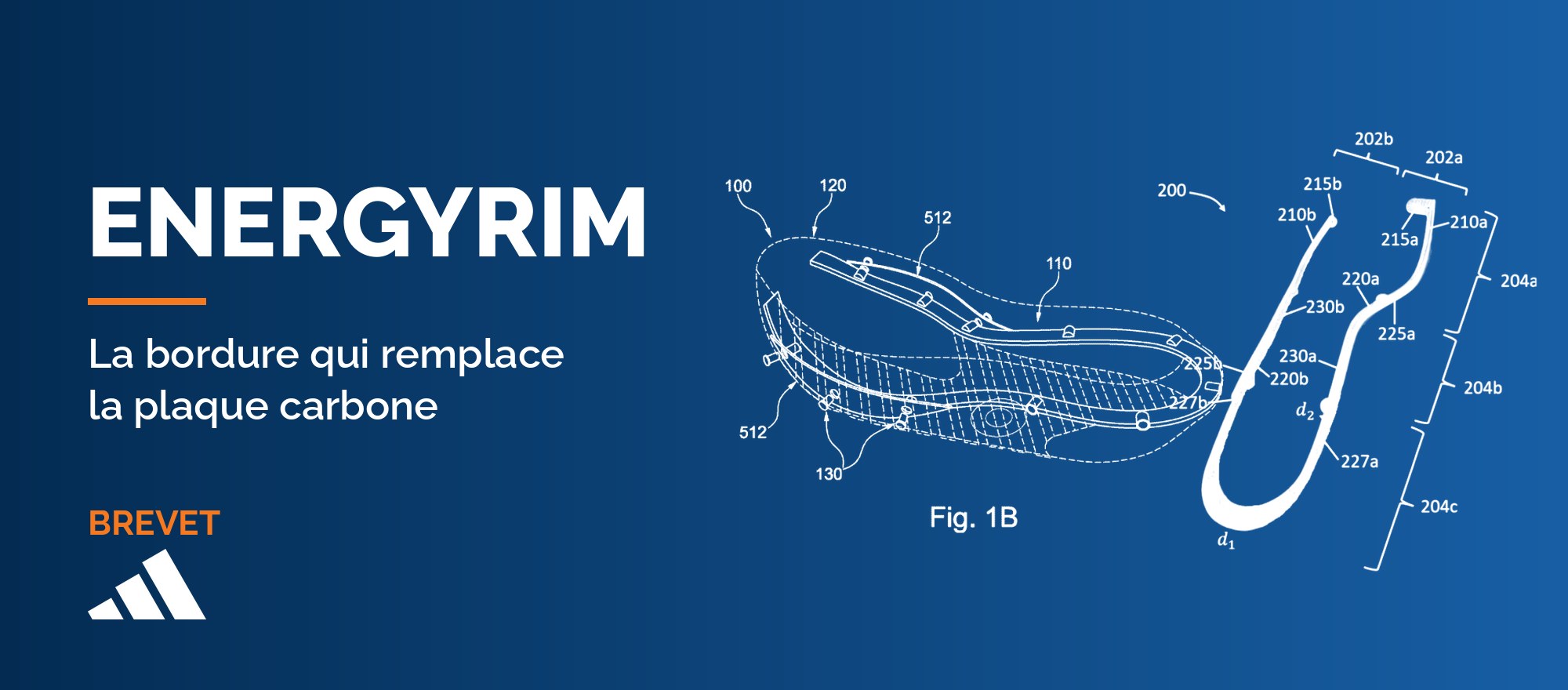
On the Adizero Adios Pro Evo 3, the carbon plate is gone. In its place, a black rim runs around the foam: adidas calls it ENERGYRIM. Two patent applications published on 15 October 2026 describe a construction that matches it line for line, then a frame onto which interchangeable parts would be attached.
In this article: the support element that replaces the full plate.
ENERGYRIM, already in the shops
ENERGYRIM is adidas’ name for a carbon rim that runs around the midsole foam, with no plate under the foot. It is used on the Adizero Adios Pro Evo 3 and on the Terrex Agravic Speed Ultra Evo, where adidas calls it Dual ENERGYRIM.


A U along the sidewalls
The first application describes a U-shaped support element. One arm runs along the medial side, the other along the lateral side, and they meet at the heel. The forefoot stays free: nothing passes under the toes.

Each arm carries a rib, a ridge that rises from a flatter base. In cross-section it can look like an L, a T, an inverted V, a Y or a C, and the profile changes along the foot. The rib is 5 to 50 mm high and can form part of the midsole sidewall.

The material is a thermoplastic, with or without fibres: polyamide, carbon, glass or aramid. The heel section can be cut out to save weight, and the element can stick out 2 to 60 mm behind the sole, in plain view. A slight curve can also be added at the forefoot.
Why a rim instead of a plate
I have always seen the plate as the backbone of the shoe. Super shoe foams are very soft and very resilient, but they deform a lot. Without a skeleton, they collapse. The plate holds the shape under compression, and its job is to keep the rocker when the foam is loaded.
The patent starts from the foam. A stiff element under the foot adds stability, but it restricts forefoot compression and costs energy return. Putting the stiffness on the edges is another way to keep the skeleton, with one advantage: under the foot, you would rather feel the foam and its energy return. The centre of the midsole stays foam, and stability comes from the sides. My engineering question remains: can a rim alone hold the rocker as well as a plate?
The heel has a second role. Because the two arms are joined, the element is a single part and the foam can be moulded directly around it. No bonding between two layers: manufacturing is simpler and the result more consistent.
The patent also describes another route: two foam layers sandwich the rim, then milling brings rim and foam flush. The sidewall is smooth, with no ridge and no hand finishing.

A last variant: the two arms are not joined, which gives two separate parts, one per side. The Terrex photo above seems to show exactly that.

How much does the rim weigh?
The patent figures have no scale, but the text gives ranges: a base 1 to 40 mm wide and 0.1 to 30 mm thick, a rib 5 to 50 mm high. I made a rough estimate for an EU 42 (UK 8). Each arm follows the outline over about 250 mm, plus the heel curve: say 500 to 600 mm of developed length. With a 1 mm thick L profile, a 12 mm base and a 15 mm rib, the section is about 30 mm², or 15 to 20 cm³ of material. At 1.45 g/cm³ for a short-fibre composite and 1.55 for continuous carbon, that gives 20 to 30 g.
A carbon plate of 100 to 160 cm² and 0.8 to 2 mm thick weighs between 12 and 50 g. Both solutions fall in the same range: on the scales, the rim does not win by default.
One constraint narrows the estimate. The Evo 3 weighs 97 g in total, with upper, foam and outsole. The rim can hardly exceed 10 to 15 g, which calls for a thin section: a 0.8 mm profile with an 8 mm base and a 10 mm rib gives 10 to 13 g. adidas does not state its reference size, which adds uncertainty.
The difference in foam volume is just as small. The plate takes 10 to 30 cm³ out of the middle of the sole, the rim takes as much or a little less out of the sides, and at 0.1 to 0.2 g/cm³ that foam weighs a few grams. The gain lies elsewhere: no stiff plane splits the foam into two layers any more. These figures are orders of magnitude, give or take half. Only cutting a real shoe open would give the answer.
What it does in races
On the racing side, the Evo 3 has won everything. In London, in April 2026, Sabastian Sawe ran the marathon in 1:59:30 and Yomif Kejelcha in 1:59:41, and Tigst Assefa set the women-only world record at 2:15:41, all in this shoe.
Figures announced by adidas, each gain measured against the previous model in the same line.
For an engineer, these figures mix everything together. The foam is new and the plate disappeared at the same time as the rim arrived: the rim’s share cannot be isolated. The weight gain of the Evo 3 does not come from it either, since my estimate puts it in the same range as a plate. Replacing the plate with a rim did not cost running economy, which does not prove that it adds any. And a race, even a historic one, is not a test bench.
The second patent: the rim becomes a rail
The second application takes the idea of a rim built into the sole and turns it into a frame: a flat, elongated structure that follows the outline of the sole, a U open towards the front. Attachment points are spread all around, at least one near the heel. The frame takes functional parts and holds them removably. It can be a plate, or part of a plate.

Many fasteners are listed: thread, screw, magnet, clip, hook-and-loop, strap, buckle, adhesive tape, snap-fit. The figures also show a quarter-turn lock.

The application imagines several families of parts. Support cables hold the midfoot: two cross on the side of the shoe and a third wraps the heel. An upper cover can be a breathable mesh in hot weather or a waterproof shield in the rain. Inverted-V structures clip onto the frame by their legs. A rigid or semi-rigid element, with a convex edge facing the ground, acts as a removable rocker. Last, an elastic band stretched along the lateral side transfers loads between the front and rear of the frame.


The uses listed point the same way: change cushioning or grip to suit the ground, for example clip-on lugs for trail and a smooth outsole indoors, or a firmer midsole for sprinting. The sustainability argument: replace a worn part rather than the whole shoe.
My view
The first application claims that the rim maximises energy return without hurting forefoot compression, but no figure backs it up. The idea is consistent with the shoe adidas sells. What the text does not say: how a stiff rim takes side impacts on a rocky trail, and how it ages when it sticks out behind the heel.
The second application is weaker. Almost every sentence is conditional and no shoe matches it. Each attachment point adds weight and can work loose after hundreds of kilometres. On a racing shoe where every gram counts, that is a gamble. For a shoe that adapts to conditions, it is an idea worth exploring.
For patent watch, the first patent explains what already exists. The second still speaks in the future tense. The frame would become a platform: one base for road and trail versions, and for a longer-lasting shoe.
Further reading
- [Brevet] Les secrets de la future adidas adios pro 3 (in French): the previous generation of the Adios Pro
- [Brevet] Les secrets des 2 lames de la Hoka Tecton X (in French): two independent plates for trail
- [Patent] Arris Composites and its carbon plate for shoes: another way to shape carbon
- Teeter Totter : l’effet qui ferait avancer les super shoes avec une plaque (in French): what the plate brings, and what a rim has to make up for
Method. This article is based on the US patent applications US 2026/0314755 A1 (“Stiffening element for a shoe”) and US 2026/0314746 A1 (“Shoe with modular rim system”), filed by adidas AG and published on 15 October 2026. The link with the Adizero Adios Pro Evo 3 and the Terrex Agravic Speed Ultra Evo is my interpretation, based on adidas visuals: the applications do not name any shoe. For convenience I write “patent” throughout, but these are applications: until they are examined and granted, they confer no patent rights, and their claims may still change or be refused. This analysis does not predict the brand’s future releases: it may reflect the designers’ work.
Leave a Reply