
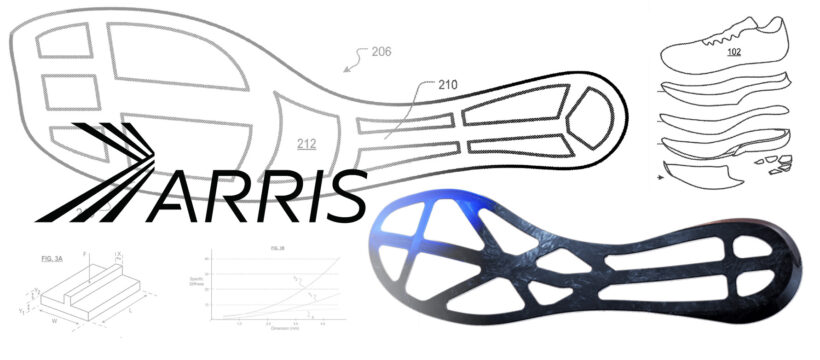
In a patent application, Arris Composites proposes a carbon fibre plate made by additive molding, whose stiffness can be tuned zone by zone through ribs and fibre orientation. The same mould can produce a road plate or a trail plate.
In this article: a carbon fibre plate with no shoe attached
This section usually covers shoe brands. Today it is a composites specialist, Arris Composites. The angle is a little different, more about mechanics than design or athletic performance, but just as interesting for what composites can do. I think it matters not only for running but also for cycling.
What is Arris Composites?
A Californian company founded in 2017, specialising in carbon fibre, with a particular process called “additive molding” that combines aligned fibres and continuous composites, two techniques developed in aerospace. The name probably means nothing to you, because they are not in any shoe yet. They are comparable to Carbitex, which works with adidas, Puma and Speedland, but their technology targets a wider industrial market. Carbitex uses a conventional laminated plate, whereas Arris Composites’ technology is entirely new in this field.
The company has a footwear business unit in Portland, Oregon, whose team includes a former On and Nike employee.
Let’s look at the specifics of the patent and of the plate the Arris Composites designers propose.
The idea behind the patent
We will focus on running shoes, more and more of which carry carbon fibre (or other composite) plates in the midsole. These act as levers that propel the runner forward and, combined with the new foams, lighter and more durable than ever, add almost no weight. Even so, a shoe is still a set of compromises between performance, comfort and so on. The Arris Composites designers therefore tried to give the carbon plate other roles beyond “performance”.
Their proposal is to use the plate to tailor the shoe’s characteristics, by controlling stiffness in certain directions and in specific areas of the sole. For example, you could limit lateral torsion while allowing natural torsion along the footbed and keeping efficient force transfer from toe to heel (lengthwise). To do this, the designers use fibre paths that are much closer to the optimum than solid carbon fibre plates allow.
A whole set of parameters can be tuned to meet specific goals for the shoe:
- the geometry (for example the cross-section shape of the ribs, their height, their orientation and layout);
- the alignment and paths of the fibres through the ribs;
- whether or not the fibres are continuous between different shoe components (that is, across the different layers of the shoe);
- variations in the resin-to-fibre ratio along the continuous fibre;
- variations in the type of resin (for example flexible TPU, rigid PC, transparent or opaque resins, resins that absorb shocks, store and return energy, or are soft or elastic).
So with the same shoe shape, many aspects of performance and comfort can be adapted to the runner’s preferences, all in the same mould, because these characteristics only depend on fibre orientation, density and length, or on the type and share of resin.
So what does this carbon plate look like?
How Arris Composites designs the carbon plate
The plate is a lattice structure: it looks like a spider’s web, with material only where it is needed to carry loads, restrain the sole or leave it free.
Take a trail shoe and a road shoe. A trail shoe designer needs to put more emphasis on ankle support, through resistance to “rolling”, than a road shoe designer. This can translate into a trail plate with more support ribs around its edge than the road plate, plus “connecting” ribs running across to stiffen the sole.
The more intersections there are between longitudinal ribs (along the foot) and lateral ribs (across it), the stiffer the plate, and therefore the shoe. Conversely, the further apart these intersections are, the lower the stiffness, all other parameters being equal.
Besides the number of ribs, another parameter matters: their height.
The figures below show how rib height and width affect stiffness (Young’s modulus). The graph is based on a piece of fibre composite 25 mm wide (W) and 50 mm long (L), of height Y1, with a rib of height Y2 and width X, under a downward force F perpendicular to the rib.

The graph shows that a rib is a very efficient way to add stiffness. A wider rib has little effect on specific stiffness, so increasing rib height in a given area is what makes that area stiffer.

Here is a plate as Arris Composites imagines it, with ribs of different heights. Section C2 of the rib is lower than section C1, towards the metatarsal heads, and section C3, towards the heel. This arrangement allows more torsional flex around that section than if all three were the same height. That flex lets the wearer’s ankle pivot, for example, while the heel stays in place.
The whole perimeter of the plate is also higher, for more stability and less lateral movement of the foot.
Finally, fibre orientation gives the plate more or less flexibility. Here are two example paths, shown dotted. By construction, the second option allows more torsional flex than the first.


Conclusion
This Arris Composites patent opens interesting possibilities. Imagine your favourite shoe in several versions: road and trail on the same chassis, with a plate tuned for stability, or a plate tuned to your taste. No more hours spent choosing between two differently built models if you feel good in one.
Their technology also seems able to reduce the material needed and the waste, and builds recycling into the process. But we will have to wait until 2024 to see a first shoe with this kind of plate. No brand has been named yet. Perhaps On, whose SpeedBoard plate already has this kind of structure.

Going further, the idea is also relevant to cycling, where carbon has been in shoes for years. Optimising weight or stiffness (for gravel or cyclo-cross shoes) is an interesting topic.
Further reading (in French)
- The secrets of the two blades in the Hoka Tecton X: two independent plates for trail running
- The secrets of the future adidas Adios Pro 3: reinforcing rods instead of a plate
Method. This article is based on patent application US2021378360 from Arris Composites, filed in May 2021 and published in November 2021. For convenience I write “patent” throughout, but this is an application: until it has been examined and granted, it does not give the rights of a patent, and its claims may still change or be refused. This analysis does not predict the company’s future releases: it may reflect the designers’ work. Translated from the original French article.
Leave a Reply