
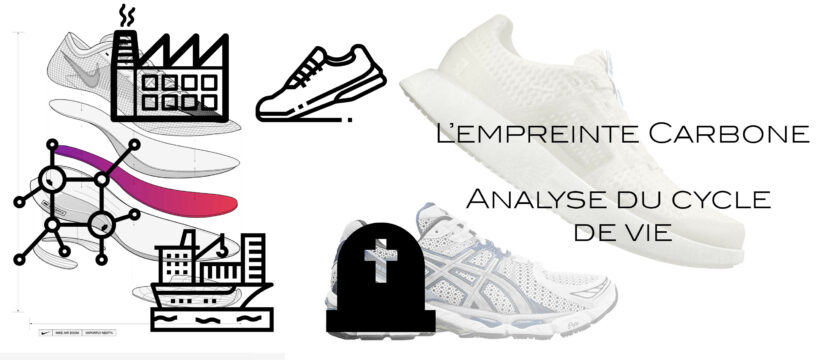
A pair of running shoes weighs between 2 and 20 kg of CO2e, depending on who does the calculation and how. Almost everything is decided before you put them on, in the materials and at the factory. And the first lever in your hands is the number of kilometres you run in them.
In this guide: how much CO2 a shoe weighs, where the emissions come from, and what brands and runners can do about it.
Updated October 2026. This guide brings together and updates my 2021 series on the carbon footprint of sports shoes. Figures added since then are dated and sourced in the text.
Why it matters
It is a subject as complicated as performance, and to my mind just as fascinating. If you think fashion, in the broad sense, weighs little, the McKinsey report should change your mind: 2.1 billion tonnes of CO2 in 2018, or 4% of global emissions. Fashion emits more than aviation.
Sports shoes take their share. In France, the Union Sport & Cycle running observatory counts 12.4 million runners and 9 million pairs of running shoes sold in 2024 (Que Choisir). Putting numbers on a pair is the only way not to judge by feel, or by marketing.
How much does a shoe weigh?
To measure a product’s impact, we use life cycle assessment (LCA), codified by the ISO 14040 standard. It follows the product from raw material extraction to end of life.
The reference study is still the one by Lynette Cheah and her MIT colleagues, Manufacturing-focused emissions reductions in footwear production. It covers an ASICS Kayano 17 (yes, it is a little dated, but it makes a good reference) and arrives at 14.2 kg of CO2e per pair, give or take 2.7 kg. More than ten years on, it is still the one everyone cites: in 2024, RunRepeat used its data to assess “eco” shoes.
Brands publish little. Nike did so in 2020 in its impact report: 16.6 kg for the Vaporfly, 10.3 kg for the Pegasus and 5.4 kg for the Free Flyknit, with no breakdown. Since then, two records have been announced: 2.94 kg for the adidas and Allbirds Futurecraft.Footprint in 2021 (Green Queen), then 1.95 kg for the ASICS Gel-Lyte III CM 1.95 in 2022 (FashionUnited). At the other end, the French agency ADEME’s Base Carbone counts 18.7 kg for a sports shoe (2018 data). And the Footwear Innovation Foundation, which measured the consumption of 33 factories in 2024, arrives at 6.7 kg for a typical running shoe.
From 2 to 19 kg of CO2e per pair
Carbon footprint of a pair of shoes, in kg CO2e, by source
Scopes and methods differ: these values cannot be compared directly.
See the data
| Shoe | Source | kg CO2e |
|---|---|---|
| ASICS Gel-Lyte III CM 1.95 | declared by ASICS, 2022 | 1.95 |
| adidas x Allbirds Futurecraft.Footprint | declared by adidas and Allbirds, 2021 | 2.94 |
| Nike Free Flyknit | declared by Nike, 2020 | 5.4 |
| Typical running shoe | Footwear Innovation Foundation, 2025 | 6.7 |
| Nike Pegasus | declared by Nike, 2020 | 10.3 |
| ASICS Kayano 17, MIT LCA | Cheah et al., 2010-2011 data | 14.2 |
| Nike Vaporfly | declared by Nike, 2020 | 16.6 |
| Sports shoe | ADEME, Base Carbone | 18.7 |
So, 2 or 20 kg? Both, and that is exactly the problem. These figures do not measure the same thing. The scope changes (the factory alone or the whole life cycle), so does the data (measured at suppliers or taken from average databases), and the records are declared by the brands. ASICS had its calculation validated by SGS, but the detailed method is not public. Comparing two values only makes sense if they come from the same method.
Where the emissions go
The value of Cheah’s LCA is the breakdown by phase. For the 2010 Kayano 17, it leaves no doubt: materials and manufacturing account for about 95% of the total. We will see that manufacturing has shrunk a lot since.
In 2010, manufacturing was two thirds of the total
Emissions of an ASICS Kayano 17 by life cycle phase, in kg CO2e (total 14.2 kg)
Source: Cheah et al., MIT, data collected by ASICS in 2010-2011.
See the data
| Phase | kg CO2e | Share |
|---|---|---|
| Raw materials | 4.00 | 28.2% |
| Manufacturing | 9.50 | 66.9% |
| Transport | 0.30 | 2.1% |
| Use (care) | 0.03 | 0.2% |
| End of life | 0.37 | 2.6% |
Materials
On the Kayano 17, the upper is polyester and polyurethane, the midsole an olefin copolymer, the outsole rubber and the packaging cellulose. These materials make up 75% of the shoe’s mass and 67% of its emissions. The upper alone accounts for 41% of the CO2 impact, PE and PU for 57%, packaging for 6%. And a third of the emissions go into production offcuts: a cost the end customer never sees.
Recent databases give between 3.2 and 5.7 kg CO2e per kilo for polyurethane depending on the type (EUROPUR 2025, ecoinvent), around 2 for polyethylene (ADEME), and about 3.4 for EVA. I had to derive that last figure from Braskem data: no public value exists. (And no, I did not pay €3,800 for an ecoinvent licence to get the exact numbers.) For a 620 g pair, that gives 1.2 to 3.5 kg CO2e, against 2.6 kg in Cheah’s study. It is a floor: rubber, offcuts and material processing are not included.
For the record, carbon fibre is around 23 kg CO2e per kilo (Wang et al., 2025). I estimate the two plates in a pair at about 1 kg CO2e, offcuts included, which explains part of the Vaporfly’s higher figure.
Manufacturing
Cutting, gluing, assembly, compression, injection: each step uses electricity and, in Cheah’s study, coal to heat the equipment that makes the soles. Electricity accounts for 4.4 kg CO2e per pair (assuming 0.88 kg CO2e per kWh) and coal for 5 kg. The data come from a survey ASICS carried out at its manufacturers in August 2010 and January 2011.
Most factories are in China and Southeast Asia, where electricity still comes largely from coal. This is where the figures have moved most since: Chinese electricity has gone from 0.77 kg CO2e per kWh (the IEA value still used by ADEME) to 0.53 in 2025.
Factory electricity has decarbonised
Electricity emissions in kg CO2e per kWh: Base Carbone values used in 2021, then 2025 measurements
Sources: ADEME Base Carbone (IEA data), used in my 2021 series; Ember 2025 via Our World in Data (life cycle intensity). The two series do not use the same method: look at the orders of magnitude.
See the data
| Country | Base Carbone | Ember 2025 |
|---|---|---|
| Cambodia | 0.809 | 0.499 |
| China | 0.766 | 0.525 |
| France | 0.074 | 0.041 |
ASICS reports point the same way. In 2019, the brand announced that manufacturing at its tier 1 suppliers had fallen from 2.45 to 1.77 kg CO2e per pair, largely thanks to a drastic cut in coal (2019 sustainability report). That is very far from Cheah’s 9.5 kg. Tier 1 suppliers probably do not cover all of a shoe’s emissions, and ASICS also produces in Vietnam, but the 2011 figures are surely pessimistic.
The most recent measurement confirms it. In 2025, the Footwear Innovation Foundation recorded the consumption of 33 factories in China and Vietnam, covering 54.7 million pairs: just over 1 kWh of electricity per pair on average, 3.32 kWh of energy in total for a sports shoe, and no more coal burned on site. The MIT study counted 6.4 kWh and 5 kg of coal per pair. The result: manufacturing now weighs only about 1.5 kg, and materials are once again the largest item.
Transport
Your shoe has travelled a fair bit before reaching you: from the raw material plant to the manufacturer, from the manufacturer to the country of sale, then to your door. Cheah estimates it at 0.3 kg CO2e per pair on average, 2% of the total. It obviously depends on the distance: add 0.76 kg for Quebec, for example.
With ADEME’s more recent emission factors (0.08 kg CO2e per tonne-kilometre by truck, 0.006 by container ship from Asia), it even drops to 0.19 kg, 40% less.
There is a strong assumption behind this: no air freight. Yet Nike’s 2021 report shows the brand uses it for part of its freight. Nike gives a ratio of 42 between air and sea; ADEME is closer to double that once contrails are counted. With air freight, transport is no longer negligible.
And distribution? ADEME counts 5 kg per pair of sports shoes. But the detail of its 2018 report shows this is almost entirely transport, including about 3 kg of air freight: its assumptions send part of the pairs by plane. Storage in warehouses and shops weighs only 0.2 to 0.3 kg, about the same as preparing an online order (ADEME 2023, via Impact CO2). What can add to the bill is your own trip: driving a petrol car 10 km each way to pick up the pair adds about 4 kg, nearly three times the manufacturing emissions of a pair in 2025.
Use and end of life
A shoe emits nothing while you run in it. Cheah only counts care: 90 litres of water for hand washing over its whole life, or 0.03 kg CO2e. I am more of a brush person myself.
End of life weighs 0.37 kg CO2e, about 3% of the total. In the United States, 80% of shoes end up in landfill and the rest is incinerated. Neither option is satisfactory: bury plastic that will turn up everywhere, or turn it into CO2.
In France, the calculation changes. About 63% of residual household waste is incinerated (SINOE, ADEME, 2012 figures). With the Base Carbone’s plastic incineration factor, a 540 g pair thrown in the bin emits nearly 1 kg of CO2e when burned. Dropped in a Refashion collection point, it emits only about a hundred grams.
What LCA leaves out
LCA is standardised, but it leaves out items that a greenhouse gas inventory (ISO 14064-1) splits into three scopes:
- scope 1: direct emissions from manufacturing (fuels);
- scope 2: indirect emissions from purchased electricity and steam, including for headquarters, design centres and shops, which LCA leaves out;
- scope 3: all other indirect emissions, including business travel.
These items could be allocated per pair, in proportion to revenue and volumes. And brands’ digital footprint (email storage, websites, social media) could be added too, and it is likely to grow.
The first lever is on your feet
Before looking at what brands can do, a question. You run 1,200 km a year and are torn between shoe A at 8 kg CO2e and shoe B at 14 kg CO2e. Which do you choose?
A? Not so fast: one piece of information is missing, durability. If A lasts 500 km and B 1,200 km, A emits 16 g CO2e per kilometre and B less than 12 g. In the end, B has the lower impact. The right indicator is not the footprint of the pair but the footprint per unit of use. Try it with your own figures:
Your shoe, in grams of CO2e per kilometre
Move the sliders: the footprint of the pair, its lifespan, your kilometres per year.
That is 1.7 pairs a year and 24.3 kg CO2e a year for your shoes.
If it lasted 50% longer: 13.5 g/km.
Scale from 0 to 60 g/km. A and B: the example in the text above.
On the shoe side, super shoe foams seem to age less well: some claim barely 250 to 300 km of life, while others seem to last up to 1,500 km (figures for guidance only). A ratio of at least 5, the same order of magnitude as the footprint gap between two products. As far as I know, no standard defines when a shoe no longer does its job, although labs such as Heeluxe, with its “Time Machine”, test ageing for many brands.
The upper can also limit lifespan: a hole in the mesh at the metatarsals, even though most shoes are now reinforced there.
On the runner’s side, stride, terrain (abrasive or not) and care all play a part. French runners replace their shoes every 11 months on average; according to Que Choisir, keeping them two years instead of one halves their annual footprint. Brushing, a quick clean: easy wins. Brands could help with repair kits, mesh patches, or resoling for lugs and tired foams.
What brands can change
Materials, the most visible lever
When people think of cutting CO2, they think first of recycled or bio-based materials. Cheah puts the gain from a recycled material at 2 to 3% of emissions; with ADEME data, which show a factor of 10 between virgin and recycled PET, it would be closer to 20%.
The reality on the shelves is more modest. RunRepeat screened 89 shoes marketed as “eco” out of 2,556 models: on average they cut the footprint by 9%, and none goes beyond 13%. Even a shoe made of 100% recycled materials would only gain about 24% (RunRepeat). The sub-3 kg records do not come from materials alone either: they combine bio-based foam, recycled polyester and factories powered by renewable energy.
Process, the least marketable lever
Combining better use of materials with a simpler process can cut emissions significantly. Fewer parts means fewer operations: the gain could be around 10%. Much of this is already done on some shoes, as knitting has removed a lot of gluing and stitching from the upper. Reducing manufacturing offcuts can bring up to 20% on some models, and reusing those offcuts as recycled material wins on both counts.
Energy
A factor of 10 to 20 between electricity in the highest-emitting countries and in low-carbon ones is easy to find. It could become a criterion for siting a factory. A caveat, though: even if a brand funds wind power or installs its own panels (a good thing), the electricity mix in the cable is the same for a whole region.
How many big brands will move a factory for this? Few, I think: there is as much to gain by improving processes on site. But young manufacturers could choose their location based on local energy.
Packaging
The box accounts for 5 to 6% of the shoe’s emissions, for a carton that often ends up in the bin. Reusable packaging like RePack? It has to be sent back, which emits CO2: not so obvious. Biodegradable or compostable options are other routes. And why not no box at all? For the runner it changes nothing in use; for the brand it mainly simplifies storage.
Transport
Fairly simple: ban air freight. Some have already done it, at the cost of longer deliveries. The last mile is a topic too: delivery by a “green” carrier or in-store pick-up.
Going further
Recycling, and closing the loop

The first step anyone can take: drop worn shoes at a Refashion collection point (in France) rather than in the bin. In 2024, after sorting, 56.8% of the textiles and shoes collected were reused, 34% recycled (including rags) and 8.7% burned for energy (Refashion). The potential is still huge: 259 million pairs of shoes were sold in France in 2024, and only about a third of used textiles and shoes are collected separately, according to Refashion (Euronews).
The hardest part is separating the materials. A running shoe contains three or four, and gluing leaves residues that degrade the plastic’s properties. If this is not planned from the design stage, it is very complex, if not impossible. Hence single-material shoes, which demand more thought at the design stage. And recycling is itself a mechanical process that costs CO2: the balance must be checked so that it does not emit more than it saves.

Circularity goes further: putting the material back into a new shoe, the same one, but new. That is the experiment adidas ran with the Futurecraft Loop, whose patent application I analysed (in French). It shows that mechanical steps are still needed, and that they too must be checked against their carbon footprint.
Local manufacturing: a good idea or not?
Let me open the debate: would producing in France reduce a shoe’s footprint? Yes and no.
Yes, because French electricity is heavily decarbonised: 0.04 kg CO2e per kWh in 2025, more than ten times less than in China. That is not the case for every European country.
No, because transport does not necessarily go down. If the materials are not produced in the same place, they travel more, and the finished product is sold internationally anyway. A few orders of magnitude with ADEME factors (feel free to correct me):
- everything produced locally with local materials, 2,000 km by truck: 0.12 kg CO2e against 0.19 kg for a shoe from Asia, less than 1% of the total;
- produced locally with materials from Asia: no gain, or even a loss if more offcuts are counted;
- half produced locally: 0.03 kg saved, or 0.2%, but enough to claim “Made in France” depending on value added;
- produced locally with materials from Asia and sold back in Asia: the footprint rises by 0.06 kg.
The real gain would come from end-to-end continental production, with more, smaller sites in the countries with the lowest-carbon electricity. And it is electricity, far more than transport, that makes the difference.
Changing the rules of the game
None of this touches the biggest issue: overproduction. Does a model need a new colourway every six months? Do we need limited editions that encourage impulse buying? In other words: end seasonal collections, and release a product only for a real improvement, like a software update.
The other limit is sales forecasting. Brands start production about two years before release, based on market studies that are not an exact science: too much material, too much stock, needless waste. On-demand production solves this, provided you accept waiting for your pair the way you wait for a car. Have a listen to this SewSew You podcast on the subject. A subscription model can also work, as Atreyu offered in 2021.
Regulation is starting to push in this direction. Since July 2026, the European Union has banned large companies from destroying unsold clothing and footwear; they will have to declare what they discard from February 2027, and medium-sized companies will follow in 2030 (ESG Today). The Commission estimates that 4 to 9% of unsold textiles in Europe are destroyed before being worn.
In France, an “environmental cost” label for clothing has existed since 1 October 2025, based on the Ecobalyse tool and on a voluntary basis. But shoes are excluded, even when they contain textiles (Carbonfact). A runner who wants to compare two pairs still has no official score.
On the brand side, carbon labelling remains voluntary. Allbirds was the first to display the footprint of each model, in 2020, and had presented itself since 2019 as a carbon-neutral company thanks to offsetting (Business Wire). Its Climate Neutral certification has since expired (Change Climate) and the brand was sold in March 2026 to American Exchange Group (FashionUnited). That kind of claim is no longer possible in Europe anyway: since 27 September 2026, Directive 2024/825 bans saying a product is climate neutral because the brand bought carbon credits (Senken). A brand can still publish the footprint of its shoes, its reductions and the projects it funds.
That leaves the M0.0NSHOT, announced by Allbirds in 2023 at 0.0 kg CO2e “without offsetting”. The zero comes from New Zealand merino wool whose farm stores more carbon than it emits: that stored carbon is deducted from the shoe’s footprint. Allbirds itself acknowledges that this calculation is not fully compliant with ISO 14067 (Allbirds). Making a pair still emits CO2. A displayed zero is a balance, and you need to look at what was subtracted to get there.
To round this off, here is an interview of Marcel Höche, formerly of adidas and then act3, by Kilian Jornet.
My view
And what is 10 kg CO2e? About 100 km by car (50 if you drive a Porsche), or 5 kg of pasta. It is hard to say what the “right” figure for a shoe is, since we cannot even measure it precisely. What matters is putting in place actions that reduce it for good. And CO2 is only part of the impact: water, eutrophication, acidification and more.
Five years after my first series, I take away three things. In fifteen years, manufacturing has dropped from the largest item to the second: 9.5 kg per pair in 2010, about 1.5 kg in 2025, thanks to the end of coal and leaner factories. Materials now weigh the most, and the car trip to buy the pair can weigh as much as they do. Recycled materials are the easiest lever to market, but not the most effective: a few percent, when process and energy promise much more. Finally, the two most underestimated levers do not depend on brands: a pair that runs 1,200 km instead of 500 more than halves its footprint per kilometre, and a Refashion collection point rather than the bin saves nearly 1 kg.
Creating a sustainable product is not just making the same product with recycled materials. The requirement has to be built in from the design stage, so the shoe lasts, can be repaired and can be recycled. And brands need to ask which business model has the least impact. Today, the range of low-footprint shoes is still thin, and above all hard to spot in catalogues.
To estimate the footprint of your own pair from its weight, country of manufacture and whether it has a plate, I built a calculator that uses all the data in this guide.
Further reading (in French)
- The Futurecraft Loop: recycling by adidas: the shoe designed to be melted down
- Inside On’s new technology: LightSpray: an upper sprayed in a single step, without glue or stitching
Method. This guide reworks and updates three articles published in 2021: the life cycle assessment, the improvement levers and the ideas for going further. Its foundation remains the Cheah et al. (MIT) LCA, the only complete independent analysis of a running shoe I have found. Figures announced by brands are self-declared. Data added in October 2026: Footwear Innovation Foundation (2025), ADEME Base Carbone, RunRepeat (2024 update), ASICS (2022), adidas and Allbirds (2021), Ember via Our World in Data (2025), Refashion (2024), Braskem (2025), Wang et al. (2025), European Commission via ESG Today, Carbonfact (2025). Translated from the original French guide.
Leave a Reply