
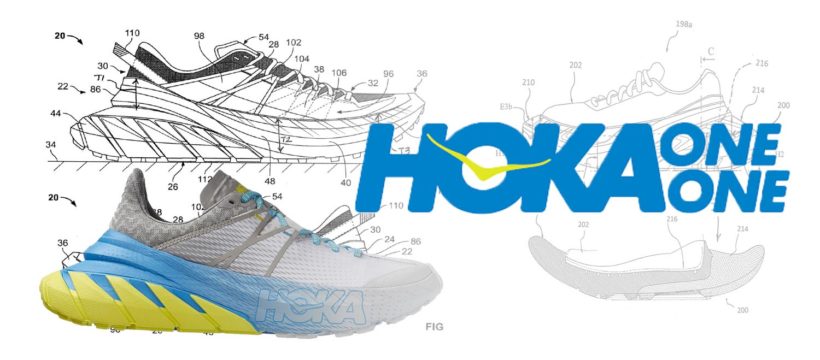
In this article: the new Hoka One One TenNine
You have probably seen this monster appear on your social feeds, a shoe out of nowhere: the Hoka One One TenNine, a very exclusive shoe released in only 3,000 pairs (half for the US, half for Europe). The shoe and its oversized sole are covered by a patent, which I take apart below.

Unsurprisingly, Jean-Luc Diard and Christophe Aubonnet are behind the patent, with Vincent Bouillard and Thibaut Poupard.
The sole aims to increase stability, reduce impact forces and improve forward propulsion. That is Hoka One One’s DNA: the brand has always wanted a shoe inspired by downhill mountain biking, with big cushioning so you are not afraid to take descents at speed.
Running basics
Running is an impact sport. When the foot strikes the ground, the impact force is three to five times body weight or more. It is especially high under the heel, and it travels up through the runner’s body. The shock and stress repeat with every foot strike, which can cause stress injuries, pain and excessive joint wear.
For Hoka One One’s designers, when the feet and ankles are properly supported, aligned and stabilised on the ground, the body can stay balanced and absorb large impact forces. And by forming an efficient lever that channels power properly during propulsion, biomechanical efficiency improves. Hence the aim: a shoe that supports, aligns and balances the runner’s feet evenly, reducing stress on the feet while improving propulsion.
The TenNine sole
The first shoe in the patent is the closest to the TenNine, apart from a few details. This is the one I describe here.

The midsole is described with three thicknesses:
- a first thickness T1 at the heel, 3.5 to 4.5 cm
- a second thickness T2 at the midfoot, 4 to 6 cm
- a third thickness T3 at the forefoot, 3 to 5 cm
You will have noticed that T1 does not include the whole sole: it leaves out the stabilising part underneath, which I cover later.
According to the patent, this construction gives more stability and cushioning under the midfoot and forefoot, to help absorb impact forces when the front of the shoe hits the ground. The midsole is ethylene-vinyl acetate (EVA).

The sole has a 9.0 cm forefoot section that curves up to a point at least 2.0 cm above the ground. The longer and higher forefoot aims to increase ground contact time and lengthen the gait cycle, that is the time between one foot first touching the ground and the same foot touching it again. Together, longer contact and a longer cycle make it easier to move over the ground, increase the push of the foot against the ground and delay fatigue while running.

Finally, the outsole includes a stabilising part (yellow) that extends outwards at a set angle θ and a given distance from the midsole. This is the part Hoka One One promotes. As the drawing shows, θ is the angle between the vertical line from the rear end of the midsole and a line along the top of the rear stabilising element. Depending on the embodiment it is between 50 and 80°, and the element extends at least 4.0 cm beyond the midsole. With this wider base near the heel, the TenNine stays relatively balanced and stable on different surfaces, including uneven ground such as your favourite trail (the Sentier des Anglais on Réunion, for example). In this version the stabilising part combines EVA and a foam material for both stability and cushioning. It also aims to increase ground contact time by making contact earlier.

A quick word on the upper, built from three parts. At the front, the tongue continues into a gusset that runs to the toe. At the rear, a heel counter (green) limits heel movement. The vamp (orange) covers the sides only.
Hoka One One’s souped-up version

Hoka One One also describes other versions of its stabilising sole technology, with different lengths.
A conventional sole extends beyond the front of the upper by about 2.0 to 25 mm, around 0.8 to 6% of the upper length (LU). The upper length roughly corresponds to the shoe size.
This souped-up version adds a front stabilising element (blue) that gives a propulsive effect at the end of the stride. Here it accounts for 9% of LU, and up to 25% in the “craziest” drawing.

In this model, the ratio between the thickness at the tip of the sole (E3b) and the thickness at the base of the front stabilising element (E3a) is 2. Hoka One One’s designers state that a fairly large thickness can store energy as the element compresses at the end of the stride and release it, like a spring, as the leg drives forward. I think that may be optimistic. On the other hand, it creates a rocker sole that rolls the foot forward, which some studies say relieves the Achilles tendon (while making the knee work harder). Podiatrist friends, feel free to correct me. Rockers are already common at Hoka One One, but this one looks very pronounced.

The rear stabilising element seen on the TenNine has a length (L3) equal to 20% of LU in this version (against 17% in the TenNine-like example). Its thickness is almost uniform, at least 1 cm (knowing Hoka One One, that really will be a minimum). Being fairly thick, this rear element improves shock absorption by compressing at the start of the stride (heel strike).


Hoka One One’s designers go even further (and since it is fashionable) by mentioning that a semi-rigid plate (such as a carbon plate) can be placed between the midsole and outsole for extra support, or a “spring” plate inserted under the heel to help absorb vertical impact, possibly running the full length to (quote, because it is a bit much) “provide a spring effect during propulsion”. That feels like a catch-all.
Conclusion

Back to more reasonable shoes: Hoka One One is not limiting this “heel technology” to the TenNine. The Clifton Edge has just been unveiled, also with an oversized sole, and judging by the images another model on steroids could be in the pipeline, along with even crazier variants.
The Clifton Edge weighs 252 g: compression-moulded EVA cuts weight significantly. Will we one day see versions with carbon plates? Race versions on the feet of Jim Walmsley and Ludovic Pommeret?
Further reading (in French)
Method. This article is based on patent application US2020100565 filed by Deckers Outdoor in October 2018 and published on 16 April 2020. For convenience I write “patent” throughout, but this is an application: until it has been examined and granted, it does not give the rights of a patent, and its claims may still change or be refused. This article does not predict the brand’s future releases: it is based only on my analysis of a patent filed by the brand and may reflect the designers’ work. Translated from the original French article.
Leave a Reply