
In this article: the sole of the ASICS MetaRide
The idea behind the patent
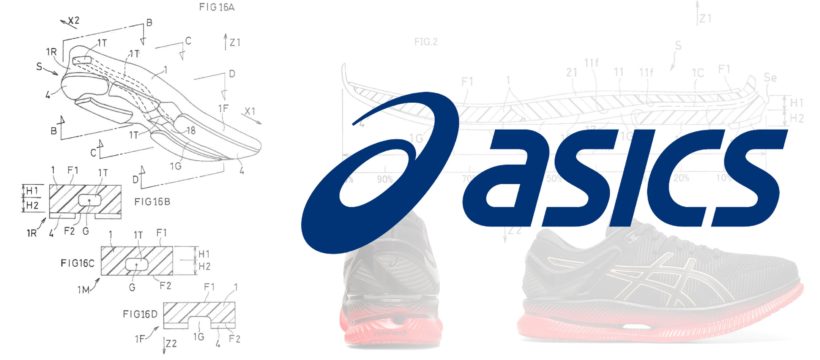
This article is about the sole of the ASICS MetaRide, released in March 2019. The shoe got people talking because of its sole: a pronounced curve with a hole in the middle. Why the void?


The patent describes a sole that improves the repeatability of the movement path (in particular the centre of pressure) as well as shock absorption and stability.
To do this, a tunnel is formed towards the rear, where the midsole is thickest, and a groove towards the front. The midsole is the right place because it is the most “absorbent” part of a sole (the outsole is too hard). The tunnel may or may not be filled with a material softer than the sole.
How it works
The figure below shows a cross-section of a dynamic model of the MetaRide sole. It looks like one of my strength-of-materials lab sessions from ten years ago 😀

When a uniformly distributed load is applied to the top of the sole, its deformed shape (from numerical simulation) looks like this. The inventors found that the deformation grows as the hollow gets closer to the top surface of the sole.
Deformation provides not only shock absorption but also stable performance and repeatability while running. The position and shape of the hollow should therefore improve each of the properties the runner is looking for.
According to ASICS, the position and shape of the hollow affect not only where the centre of pressure lies but also how fast it moves (Vc).

While running, a moment is generated around the joints and loads the muscles. Its magnitude is the cross product of the ground reaction force vector and the distance to the joint (the lever arm). The force acts at the centre of pressure, so controlling where the centre of pressure lies controls the size of the moment.
This moment peaks several times during stance at the knee, and once at the ankle. Controlling how fast the centre of pressure moves should therefore help, particularly between 30 and 40% of the length from the rear end and between 50 and 100% from the rear end, which correspond to those moments.
To follow what comes next, look at the MetaRide sole drawing just below.
If the hollow slopes upwards towards the front (direction X1), the sole becomes easier to deform towards X1, so the centre of pressure should move forward faster and faster. Conversely, if the hollow slopes down, deformability decreases along X1 and the centre of pressure should slow down.
The MetaRide: it is all in the sole
The ASICS sole is divided into several zones according to the functions above, based on a heel strike.

Here is the path of the centre of pressure in a heel strike. Keep it in mind for what follows.
Between 0 and 10%, the structure rising towards the front (X1) encourages the centre of pressure to start moving forward smoothly after landing.
In the rearfoot, especially between 10 and 20% from the rear end, the ground pushes back hard, so strong shock absorption is needed. That is why the tunnel sits in the upper half of the midsole there: it makes the sole easier to deform.
As described above, the moment around the knee peaks between 30 and 40%. At that point, the centre of pressure is considered to be ahead of the knee (towards X1). Keeping the centre of pressure as far back (towards X2) as possible is therefore seen as important, to slow it down.
So between 30 and 40% from the rear end, the tunnel slopes downwards to reduce the speed of the centre of pressure.
Between 50 and 80%, seen from behind, the ankle joint, the centre of pressure and the knee joint are considered to lie in that order. To reduce the distance between the knee and the centre of pressure, the centre of pressure is pushed forward as much as possible, so it speeds up. To reduce the distance between the ankle and the centre of pressure, it is held back as much as possible, so it slows down.
As you will have gathered, there are therefore two options:

- To reduce the load around the knee, the tunnel sits closer to the top of the midsole between 50 and 80% from the rear end, as in the first drawing, so the centre of pressure moves faster.
- To reduce the load around the ankle, the groove (1G) sits closer to the bottom of the midsole, as in the second drawing, so the centre of pressure moves more slowly.
For the MetaRide, ASICS chose option 2, to favour ankle support.
The Japanese brand’s GlideRide is a variant from the same patent. Here, a channel ends in a cavity closed by a gel insert.

ASICS’ results
ASICS tested several of these concepts to check how well they meet each goal.
Test shoe ex. 1 has a tunnel at the rear followed by a groove section. For comparison, Comp. 1 has only a groove, and Comp. 2 has neither.
As the figure shows, Test ex. 1 is clearly better than Comp. 2 for repeatability while running, and better still than Comp. 1. The likely reason, according to ASICS, is that the centre of pressure is guided along the tunnel and then the groove, which makes its path more consistent.

The next figure shows that Test ex. 1 has a lower loading rate and therefore absorbs shocks better under the rearfoot than Comp. 2 and Comp. 1. The reason is that the tunnel deforms more, as the numerical simulation showed.

Test shoe ex. 1, with a rising tunnel at the rear, reduces the speed at the first peak discussed above, while test shoe ex. 4, with a rising tunnel under the midfoot, increases the speed at the third peak.

Conclusion
The shoe, or rather shoes, described in this patent are designed around a heel strike, to improve runner comfort through shock absorption. The ASICS Institute of Sport Science, behind most of the studies in the patent, used an interesting set of tools to bring this sole to market: numerical simulation and comparative tests of different configurations. An in-house biomechanics lab able to run this kind of study is a necessity for innovative brands, and ASICS shows it again here.
ASICS talks a lot about energy return with this shoe; the patent says nothing about it.
Further reading (in French)
Method. This article is based on patent application EP3542660 filed by ASICS Corporation. For convenience I write “patent” throughout, but this is an application: until it has been examined and granted, it does not give the rights of a patent, and its claims may still change or be refused. This article does not predict the brand’s future releases: it is based only on my analysis of a patent filed by the brand and may reflect the designers’ work. Translated from the original French article.
Leave a Reply