
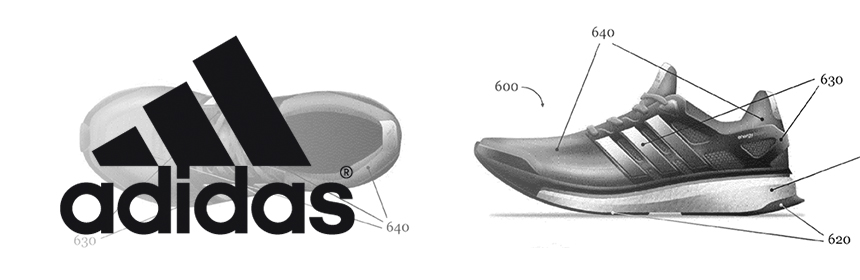
In this article: an analysis of three patents covering the sole of the upcoming Ultra BOOST
eTPU
eTPU stands for expanded thermoplastic polyurethane, the basis of adidas’ Boost sole. This material, developed by BASF, underpins all three patents. Patent EP2649896 opens with a comparison between eTPU and EVA (ethylene-vinyl acetate), which competitors such as ASICS often use.
adidas puts forward five properties of eTPU compared with EVA:
- Durability: after 100,000 compression cycles, eTPU degrades less, with 60% less permanent compression than EVA, so the sole lasts longer.
- Compressibility: on the same stride, an eTPU sole compresses by about 4 mm against only 1 mm for EVA. The shoe is very comfortable on landing.

Compression of EVA and eTPU over one stride - Energy loss: the energy used to compress the material that is not returned when it expands (lost as heat, for example). For the runner, this is the energy put into compressing the sole at impact (and absorbing the shock) that never comes back. The patent claims a 25% improvement with eTPU.
- Hardness that does not depend on temperature: everyone has noticed that EVA soles feel like concrete in very cold weather and perfect at 20°C. eTPU keeps an almost constant hardness whatever the temperature, so its properties stay the same.
- Thermal insulation: 30% more insulation than EVA, so the sockliner, which also insulates, becomes much less useful.

All this adds up to adidas’ key selling point: comfort. The patents insist on it.
Designing the soles
Patent EP2649896 sets out the design options eTPU opens up.

The first option puts eTPU where the impacts are: under the heel to absorb the impact and provide comfort, and under the forefoot, which touches the ground last in a heel strike. There, eTPU provides an elastic padding that returns part of the impact energy as the foot leaves the ground (zone 211). The rest of the sole, zone 212, can be EVA or expanded PP: lighter, and better at handling lateral accelerations and stride “deviations” (pronation, supination, etc.).

The second arrangement leaves an eTPU-free zone only at the very front, under the toes: a forefoot that is too soft can give an unpleasant feeling of the foot sliding inside the shoe and cause blisters (according to the patent). You can recognise the sole design of the adiZero Boston here.
The patent describes other options (soles with different eTPU “grains”, different densities, preferred eTPU zones for better insulation) that I will not cover here. Note that the resulting sole is so comfortable and so well insulated that adidas proposes to reduce the sockliner to a minimum, or even remove it.

Patent EP2767181 brings a second feature of the German brand’s soles: elements embedded in the sole. A material like eTPU can trap reinforcing and support elements inside the sole structure without any adhesive. The element in the drawing, for example, improves the stability and the controlled deformation of the sole while keeping an expanded material.

This brings to mind the brand’s Torsion Bar, the element that lets the front and rear of the shoe twist independently.
The other brand element that can be embedded in the sole is the “heel clip“: a structure with two fingers and a recess in the middle. Its purpose is to hold the rearfoot with the two fingers while avoiding rubbing on the Achilles tendon.
Once you have a comfortable midsole, one part remains: the outsole, covered specifically by patent US2014223777. Randomly arranged eTPU gives a light sole that absorbs shocks well, but it needs control elements to transmit forces properly.

The outsole has protrusions (138), stiffer than the eTPU midsole, and recesses (132). Once in contact with the ground, the protrusions deform and press into the eTPU midsole to transmit forces and tune its bending properties.
The sole, and especially the heel area, takes higher shear stress when a heel striker lands. Under the forefoot, on the other hand, support and stability are what matter at the end of the cycle, when the foot pushes off.
The graph below shows that at impact, the eTPU sole with an EVA rim allows more shear deformation (2.4 mm) than an EVA sole (0.6 mm), which means better shear absorption between the outsole and the top of the midsole.

Combined, these features also give a sole that is more stable at impact, with less lateral deformation (0.5 mm) than an EVA sole (1.1 mm). At toe-off there is no lateral deformation either, which means more stability and a livelier ride.
Manufacturing

The sole is made in three main steps:
- The thousands of eTPU beads, 3 to 8 mm in size, are first loaded at random into a mould. This is a big advantage: no need to align them to get the expected properties.
- The mould volume is then reduced to the final sole shape, which compresses the eTPU. This step directly sets the density and hardness of the sole.
- The mould is then filled with steam to fuse the particles together into the granular sole. It is cooled and finally opened.
Additional parts such as the Torsion Bar or heel clip are preferably included in the midsole by surrounding them with the expanding material, which avoids glue. Another option is to use the chemistry of materials from the same family (TPU and eTPU, for example) to create a strong bond without glue.
The patent states that the outsole can be laser-cut from a blank that includes the protrusions. Many blanks can be made, and the open areas cut according to the final shoe: one blank, several possible models. This kind of cutting also allows customisation, though not for ordinary runners just yet.

The Ultra Boost

These three patents lead to what adidas calls the most advanced running shoe it has ever made: the Ultra Boost. Technology has a price, though: €180, on sale from 11 February.
Everything is there: a sole with two eTPU densities, 3,000 capsules in all, a minimal sockliner, Torsion Bar and heel clip on the midsole, and a “spider web” outsole.
You can always question its effect on running efficiency, but I think it will probably be the most comfortable shoe the German brand has made.
We will have to wait for the reviews, which should appear by the end of February, to learn more about how it feels. As always, the energy gain will be hard to judge properly.
This video shows how it is made:
Given what the patents describe, there is still room to improve the Ultra Boost sole, maybe for a version 2.
Boost technology has also recently come to the brand’s outdoor shoes: the Terrex Boost.
Meanwhile, for hands-on reviews of adidas shoes with a Boost sole, see Daddy the Beat, Greg Runner or Jahom (in French).
Further reading (in French)
- The secrets of the future adidas Adios Pro 3
- adidas Futurecraft Strung, or optimising the upper
- The new adidas upper
Method. This article is based on patents EP2767181, EP2649896 and US2014223777A1 filed by adidas AG. For convenience I write “patent” throughout, but these are applications: until they have been examined and granted, they do not give the rights of a patent, and their claims may still change or be refused. This article does not predict the brand’s future releases and is not a shoe review: it is based only on my analysis of patents filed by the brand and may reflect the designers’ work. Translated from the original French article.
Leave a Reply