
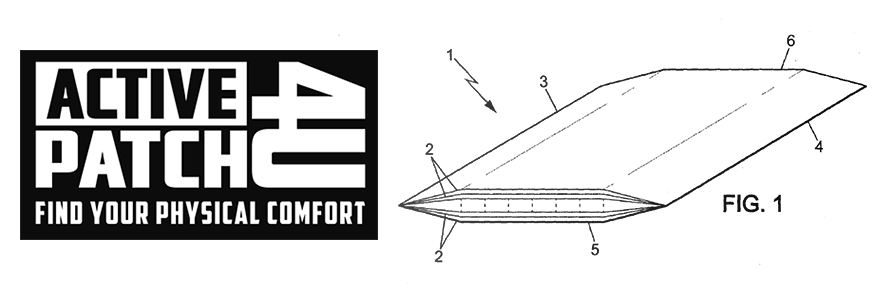
In this article: an analysis of the ActivePatch4U patent
A short history of Stimcare
In 2008, Jacques Casper, who ran Bioenergy Research Center with Arnaud Tortel and Jean-Michel Devèze, filed a patent on a composite film that reflects far infrared, without disclosing any application: EP1816254.
In 2009, Arnaud Tortel and Jacques Casper set out to improve the membrane. After two years of testing, notably with the Salomon team, they filed in 2011 the patent I describe below.
In 2020, Active Patch 4U closed and Arnaud Tortel launched Stimcare. This is the original patent. Arnaud Tortel has since filed another one describing the improvements made between ActivePatch and Stimcare, in particular on the thickness of the metal oxides.
How the patch works

The patent covers a multilayer material made of ceramic-loaded polymers that reflects far infrared. It improves on the 2008 patent: higher efficiency and a wider reflection spectrum.
Witchcraft? Apparently not, just the way life on Earth works.
As the patent describes it, the material is meant to promote the resonance and activation of the water molecules in our cells through the absorption of infrared with wavelengths between 4 and 14 micrometres. The body emits this infrared naturally (as heat), so the inventors use a “patch” to send it back.
According to the patent, the resonance of the body’s water has the following effects:
- a slight rise in skin temperature (0.2°C) and a feeling of warmth
- more blood flow, as the vessels dilate
- a more active metabolism and less pain
From these effects come body responses that could “potentially” (the patent’s own word) improve some functions. For athletes:
- better venous return
- better flexibility
- a lower heart rate
- faster cell repair
- less stress and muscle fatigue
- more endurance
The products carrying these patches are designed so that the patches sit on specific areas, depending on where the wearer feels discomfort.
The current solution has a very short life. To work at its best, the membrane foam has to stay sealed: after about ten days the patch gets clogged with sweat and skin secretions, and the membrane loses much of its efficiency. Until there is a way to restore it, this limits the possible products.
What the Stimcare patch is made of
The composite material contains more than 10 metal oxides and ground rare earths of micrometric size (around 5 micrometres) in precise concentrations, about 30 g per m². These particles are dispersed in a polymer matrix and make up 30% of the final material by weight.
Dust off your chemistry notes. For your shopping list before the recipe, here are the prices per tonne 😉
| Oxide | Concentration (% by weight) | Common name | Price per tonne |
| TiO2 | 30 to 40% | Titanium dioxide | $1,500-2,500 |
| SiO2 | 10 to 20% | Silicon dioxide | $600-800 |
| MnO2 | 10 to 20% | Manganese dioxide | $600-900 |
| Al2O3 | 10 to 20% | Alumina | $500-800 |
| Fe2O3 | 5 to 10% | Ferric oxide | $600-800 |
| MgO | 3 to 7% | Magnesia | $185-260 |
| Co2O3 | 3 to 7% | Cobalt(III) oxide | $20,000-30,000 |
| ZrO2 | ≤5% | Zirconium dioxide | $10,000-30,000 |
This composition is very close to Jacques Casper’s patent EP1816254. After a few years of research with Arnaud Tortel, they added the ingredient that noticeably raises the patch’s emissivity: carbon particles, as activated charcoal or graphite, around 5% by weight ($1,000 to 2,000 per tonne).
As the two graphs show, activated charcoal raises emissivity by around 5%, and so improves how well the infrared is reflected.

The recipe for a patch (the slightly technical part)
Budding chemist, I can tell you now want to make your own patch at home. Once your shopping list is ready, here are the details of the Stimcare recipe, as the patent describes them.
The ceramic particles and the activated charcoal are dispersed in a liquid polymer matrix (polyurethane) that contains a cross-linking agent (a polyisocyanate such as 4,4′-diphenylmethane diisocyanate).
A thin layer a few micrometres thick is then spread on silicone transfer paper, dried at 60°C, then cured at 160°C: the heat links the polymer chains together and forms a sheet.
The transfer paper is peeled off, and the composite sheet is cut and stacked to form a 10-layer material, joined by ultrasonic welding.
To make the patch, a cotton-Lycra fabric is coated with an elastomer that forms the adhesive film, and the composite material is rolled out on top of it.
Last comes the protective film, removed before use.

And there you have it: an ActivePatch4U, or a Stimcare.
As the patent states, the composite material can be applied to any kind of fabric. More on that in “Beyond patches“, but it opens up quite a few possibilities.
The clinical tests

The tests below fall outside the patch’s current use. The patch is not a medical device but a wellbeing product meant for comfort. The tests are therefore not necessarily part of the patch’s stated uses; their main purpose was to find where to place it.
This is why patch placement matters, and it depends on each need. A map of placements is available on the Stimcare website, with tutorials. The patent details four examples:
Venous return, measured with compression stockings and with plain non-compressive stockings that have patches built into the fabric. Conclusion: the patched stockings help venous return, especially in unfavourable positions (standing), with results similar to class 2 or 3 stockings.
Rest and sleep: at least 4 patches (temples, between the eyes, back of the head, etc.) worn day and night for a week by 30 people aged 22 to 67 who reported trouble falling asleep, waking at night or getting back to sleep. 21 of the 30 reported an improvement, from falling asleep more easily to no longer waking up.

Heart rate: the subject lies down with a heart rate sensor on the right ear and relaxes until the heartbeat signal is steady. Heart activity is then measured for 10 minutes, with and without patches placed on the body between the navel and the eyes. The result: heart rate 5% lower and better-regulated heart waves. There is room for doubt: 5% at rest is about 2 bpm, and this is the kind of exercise you always do better the second time, once more relaxed. Arnaud Tortel adds that the effect on heart rate appears after 12 hours of wear.
A study on wound healing showed “a very positive effect on healing speed” (though using the patch on a wound is not recommended today).
The last study looks at flexibility, with a test measuring the distance between the hand and the floor. Three patches were placed between the vertebrae and two more on the sternum and the lumbosacral junction of 40 people aged 18 to 70. In 80% of cases, the hand-to-floor distance dropped by 2 to 5 cm after wearing the patches (for an unspecified time). The patent does not say whether any exercise took place between the two measurements.
These tests are limited given what the patch could do, and a patent is not a peer-reviewed journal. To me, though, they show that the people behind the patch are serious and want to quantify the material’s effects precisely.

Beyond patches
The patent leaves the door open to any product using this material.
Other uses are being considered and will probably appear soon: compression stockings, orthoses, perhaps recovery socks. Also planned is a repositionable tape that lasts 10 days, to keep the patch at full efficiency 😉
Expect ActivePatch4U Stimcare to grow over the next few years.
For feedback from people who wore the patch (in French):
Les sentiers du Phoenix
Nicolas Raybaud
Method. For convenience I write “patent” throughout this article, but this is a patent application: until it has been examined and granted, it does not give the rights of a patent, and its claims may still change or be refused. This article is not a test of the patches. It is based only on the analysis of patent application FR2994393A1, filed by Arnaud Tortel and Jacques Casper through their joint company Bioenergy Research Center. Translated from the original French article.
Leave a Reply