
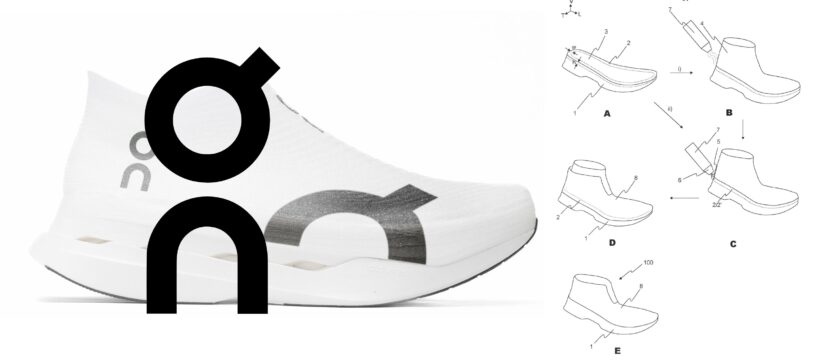
The upper is no longer made, it is sprayed. In patent application WO2024133187A1, On describes a nozzle that lays a thermoplastic filament in loops directly onto the last and fuses it to the edge of the sole: no stitching, no glue, no strobel.
In this article: what lies behind the Cloudboom Strike LS and its LightSpray upper.
The version people talk about less
The Cloudboom Strike gets a lot of attention right now, with its removable midsole, the Bounceboard in Helion HyperFoam. But On has an even more radical version in the pipeline: the Cloudboom Strike LS. From my research, LS stands for LightSpray, the name of the method used to make the upper.


Here the innovation is not in the sole. It is in the upper and in the way it joins the sole.
Five years of work before the shoe
A bit of history first. On has been working on this technology for more than five years, from a time when the brand had no super shoe in its range. The first patent application, published in March 2022, already described making an upper by laying down a filament of molten thermoplastic.
Going back further, you find Johannes Voelchert, one of the named inventors. As a student at Burg Giebichenstein in Halle, he worked on a gun that sprays TPU directly onto a person’s foot. This is exactly what technology watch can pick up early: the idea exists years before the product.


On has published a short video on the history of LightSpray, worth a look.
What a glue-free bond changes
Usually the upper is held to the sole by stitching and glue. Both can degrade over time, especially in running. On’s engineers replace them with a direct bond between two thermoplastic materials.
Because the bond is made from the outside, the strobel can go, and even the sockliner. Less weight, so more room for foam without exceeding the 40 mm allowed by World Athletics. It is the same logic as the Bounceboard, which puts the foam right under the foot.
For the runner, no stitching and no glue also means fewer pressure points. And the upper fits the foot more closely: with a 3D scan, you can make a custom last, for example by additive manufacturing, and spray the upper onto it.
On registered three versions with World Athletics, and a fourth was already declared as a prototype.


How the shoe is built
The shoe has two components: a sole with a thermoplastic rim, and a thermoplastic upper. The whole patent rests on these two parts and on the direct bond, by fusion, between the sole rim and the upper.
The upper is a filament laid down in regular loops. This structure makes it flexible and strong, and it adapts to the shape of the foot. It reminded me of a patent from The North Face (in French), where extruded fibres were laid onto a last to form a nonwoven network.

Additive manufacturing of a “solid” or flat upper is fairly simple. Printing a textile with an ordered pattern, like a knit, is much harder: beyond the cost, the filaments tend to stick to each other where you do not want them to. That is the problem On’s nozzle solves.
Manufacturing in five steps

Everything happens around an articulated arm:
- The sole is prepared with its thermoplastic rim.
- The last is placed on the sole to hold it during manufacturing.
- The sole rim is heated to 200-250 °C until it becomes soft.
- The nozzle lays molten thermoplastic on the heated rim and builds the upper.
- Everything cools down: upper and sole are now one piece.
The secret is in the nozzle

The nozzle has a central outlet for the thermoplastic and several air outlets around it. Pressurised air at around 500 °C guides the filament and gives it a helical shape. The result is a mass of loops that cross without tangling and imitate a knit.
By changing the pitch, slope or radius of the helix, you change the shape of the loops: tight loops where the upper works hardest, wide loops where it has to flex. It is the principle of a zoned knit upper, without a knitting machine.
My view
After years when all innovation went through the sole, it is refreshing to see the upper become the topic again. On paper, LightSpray removes stitching, glue and the strobel in one go.
I still have two questions. First, it feels like The North Face patent again, and that one never became a product. What makes On succeed? Probably the speed of the robotic arm, and that will decide whether LightSpray stays a record shoe or reaches mass production. Second, if the upper and the sole rim belong to the same thermoplastic family, recycling becomes an interesting question. The patent says nothing about it.
What happened next
A limited edition of the Cloudboom Strike LS was offered to On members from 30 October 2024 in New York, Paris and Shanghai, then Tokyo and Seoul (On press release). Hellen Obiri had already worn it in Boston and at the Paris Olympics. According to On, the LightSpray upper emits 75% less CO₂ than the other uppers of its running shoes, and the brand has set up a fully automated production unit in Zurich, then a second machine in New York.
A new colourway, White/Lime, came out in April 2025, the first of three Cloudboom Strike LS launches planned that year (T3).
Further reading (in French)
- How Puma will design its custom uppers: the other approach to the made-to-measure upper
- Tomorrow’s shoes by The North Face: the patent LightSpray brings to mind
- adidas Futurecraft Strung, or optimising the upper
Method. This article is based on patent application WO2024133187A1 from On Clouds, filed in October 2022 and published in June 2024. For convenience I write “patent” throughout, but this is an application: until it has been examined and granted, it does not give the rights of a patent, and its claims may still change or be refused. This analysis does not predict the brand’s future releases: it may reflect the designers’ work. Translated from the original French article.
Leave a Reply