
In this article: an analysis of the patent behind the shoe’s adaptive system
The concept
The invention starts from an observation: today’s shoes are often “optimised” for two phases of the stride. Cushioning, with elastic materials in the sole that compress on impact, and propulsion, which tries to return part of that impact energy through materials that are also elastic. The inventor points out that this kind of optimisation has limits: the energy comes back while the foot is still flat, which does not propel efficiently, and these shoes are often single-use, made for walking or for running. The Aira, for example, is ideal for running but not necessarily for walking.
Christian’s idea was therefore to develop a shoe that:
- allows a normal gait when walking or running
- respects the natural stride
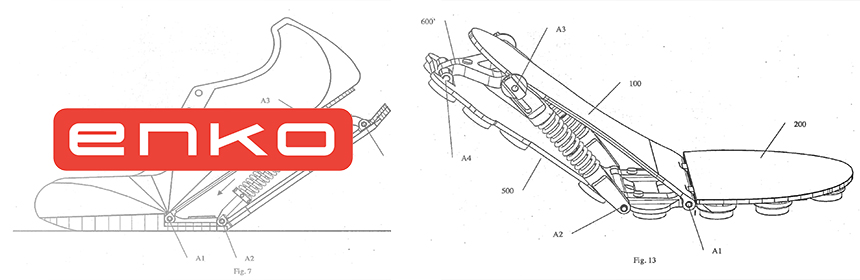
His research led to a shoe made of an upper and a sole split into two sections:
- one attached to the rear and middle of the upper
- the other attached to the forefoot
The two sections pivot around an axis placed under the foot’s natural joint.

Add a shock absorber that acts as an energy store, and you get the sole above.
*The drawings shown here are the closest to the product under development. A simpler triangular version (without parts 500 and 600) with a heel insert is also described in the patent.
How does it work?

At impact, the kinetic energy of the foot becomes elastic potential energy in the shock absorber. Given the size of part 600, I expect the cushioning to be among the deepest on the market.

During stance, the system is held compressed by a toggle mechanism that reaches dead centre at the end of the cushioning phase. For a short moment the shoe looks like a conventional shoe, but it behaves completely differently. A conventional shoe returns the stored energy almost instantly. Here nothing happens until the runner lifts the heel. This is one of the main advantages of the technology.

In the propulsion phase, the shock absorber gradually releases the stored energy. The energy is delivered at the right moment and, in the patent’s words, this slow release is gentler on the ligaments.
Adjustments
The patent states that the shoe can have one or two shock absorbers on each side of the upper. With two, adjusting them would make it possible to manage pronation.
The shock absorber tension, the position of the joints and the type of sole can be adapted to the runner’s weight, pronation, stride length, the gradient and the ground.
The patent also describes an “off” mode in which the stride is neither assisted nor cushioned. It is activated by locking the two parts in the “stance” position.
Conclusion: wait and see
I welcome the ambition of this company, a French one, to innovate and even to reinvent the shoe. But I wonder whether there is a market for a shoe with mechanical “assistance”.
On paper it works perfectly. What about real life? We will have to wait for the first tests.
I would like to see a proper study of the energy gain of a shoe that claims to make the stride more economical: joints mean losses, and nothing is said about total weight compared with a conventional shoe.
Is the stride really more natural? I would be very interested in a biomechanist’s view.
One last question: will it work on ground less even than a track, with a stone stuck in a shock absorber housing? In short, how reliable is the whole system?
Note that since 2005 the IAAF decides whether shoes are approved (rule 143.1) and has already banned some shoes with spring technologies.
So: wait and see.
[Update, 8 January] Comments from Christian Freschi
After the article came out, Christian contacted me to answer my questions. Here is an extract.
On the expected gain: “Having appreciated your comments and your conclusion, I wanted to let you know that by the end of the week you will find a calculation note on the performance gain in the Tech tab of our website. Performance is neither the main quality of this shoe nor its aim. As the note shows, above 18 km/h there is no longer any performance benefit, in theory or in practice. The slower the runner, the larger the performance gain, up to 14%.”
Banned in competition? Yes: “This shoe will indeed be banned in competition because it gives a real performance gain. Our goal is that it is not completely banned in regional road races. A ban on podiums would be normal, but it would be a pity to deprive tens of thousands of runners, who start races for pleasure rather than to win, of their favourite shoes. The aim of the ENKO RUNNING SHOES concept is not competitive performance but the runner’s wellbeing and long-term health. Its cushioning is exceptional because it works over 20 mm of travel (2 to 3 mm on a conventional running shoe), and it is effective because the shoe is adapted to the runner’s weight simply by changing the springs.”
A natural stride? “Midfoot and especially forefoot striking is the best way to run: cushioning and energy return are natural, so why look for assistance? The reality is different: most runners land on their heel. […] Teaching all these runners to run on their forefoot would be torture, and most of them, the majority of amateur runners, would never manage. The ENKO is well suited to all these forgotten runners. It is also ideal for beginners: no learning is needed.”
Reliability? A considered topic. “Another advantage of the ENKO concept is the use of interchangeable grip pads: you only replace the worn areas. This can double the life of the shoe. The springs last for more than a million cycles, so the cushioning never degrades, unlike the soft materials of current soles.”
“Stones are not a problem: the sole materials are hard and smooth, stones cannot get stuck and fall out easily because all the parts are constantly moving. A large stone between the two soles is less dangerous than a large stone under the sole of a traditional running shoe, because it twists the foot less. Branches and mud would quickly cause problems, but this is a road shoe through and through and it is not designed for trail running.”
The brand is running a crowdfunding campaign on Indiegogo from 1 February to 1 April to raise the funds needed to industrialise the shoe.
Method. This article is based on patent FR2972906, filed by Christian Freschi under the company name GECIS. For convenience I write “patent” throughout, but this is an application: until it has been examined and granted, it does not give the rights of a patent, and its claims may still change or be refused. This article does not predict the brand’s future releases: it is based only on the analysis of patents filed by the brand and may reflect the designers’ work. Translated from the original French article.
Leave a Reply